

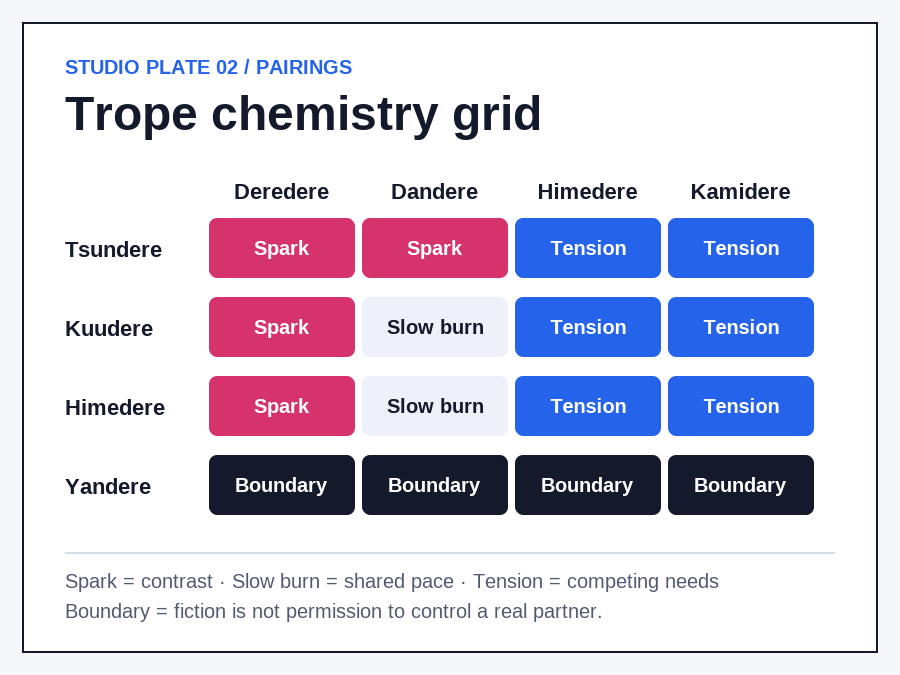
From affection to fixation
The label is commonly explained as a blend of yanderu (being ill or unwell) and dere-dere (openly enamored). That wordplay is a fandom shorthand, not a reason to equate mental illness with abuse. A character can begin with generous attention that feels safe to others, then reveal that they think closeness entitles them to make decisions for someone.
A convincing scene puts the other character’s choice on the page. Waiting for a reply can be sad or frightening; deciding the other person owes a reply changes the scene. If someone sets a limit, the response to that limit is more telling than a dramatic speech.
Two versions of the tension
In a quiet-fixation reading, reassurance never quite lasts. The audience notices how ordinary details are reinterpreted as proof of being loved or discarded. In an overt-control reading, the fixation is no longer private: the character makes demands. These are descriptive writer’s categories, not canonical subtypes. The first can sustain suspense; the second needs credible consequences and agency for others.
“Can you tell me where we stand?” works as a vulnerable question.
“You don’t get to say no” marks a boundary violation, not a bigger confession.
Pairing is a dramatic device
A Kuudere foil can say no without escalating. A Kamidere who expects the last word can intensify conflict rather than solve it. The grid marks boundaries regardless of the partner: affection does not make isolation, monitoring or coercion acceptable. Compare the sixteen tropes or return to the test.
Glossary sources: Shogakukan: dere-dere · Shogakukan: tsundere