
What gives the trope its shape?
The name combines tsun-tsun, a prickly or stand-offish manner, with dere-dere, visibly softening in affection. The interesting part is the gap between what the character can bear to say and what they choose to do. An extra umbrella that was obviously packed for someone is stronger characterization than a generic insult.
A writer might give the character a reason to resist open affection: fear of becoming a joke, a rivalry that sets public expectations, or simply a habit of talking through teasing. Show how the response changes when the audience leaves. It keeps the device from becoming a personality label pasted onto every scene.
Harsh first and warm first
In a common fandom convention, Type A starts with a prickly baseline and earns occasional moments when the guard slips. Type B is warmer most of the time, then gets defensive when the affection is noticed. You can write either as an arc (warming over a season) or as quick shifts inside one conversation. Labeling the baseline is more useful than counting angry lines.
“I’m not waiting for you. It just happens to be raining here.”
They hold the umbrella so far over their friend that their own shoulder gets wet.
Pair the contrast, not the insult
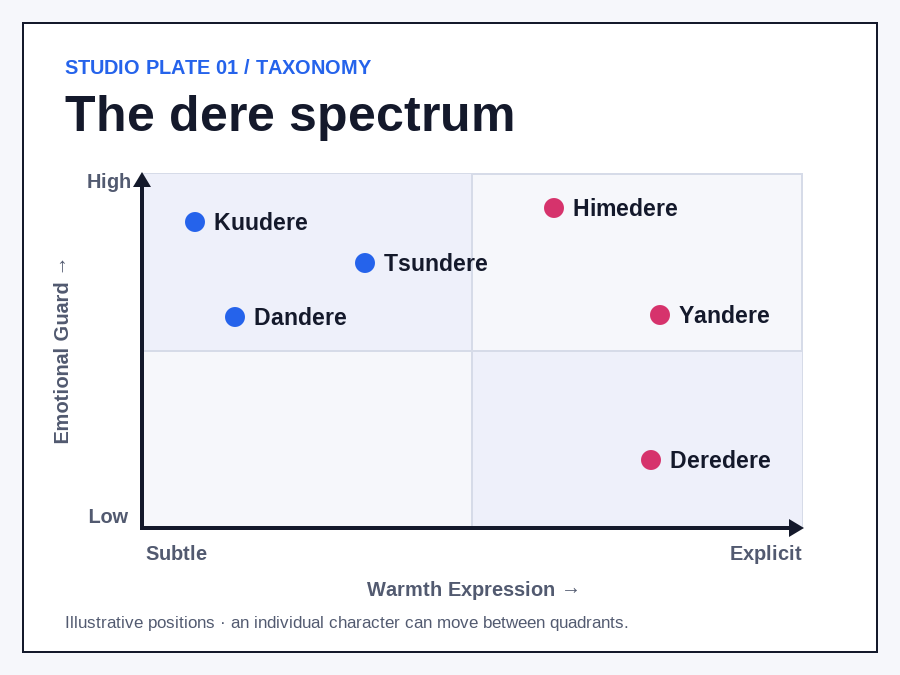
A Deredere can notice the gesture without making the deflection a public joke. A Kuudere might respond so quietly that the signal stays unread, which makes a delayed acknowledgment satisfying. A Bodere can match the sharpness too quickly; try a pause in which either character can repair the remark. A relationship doesn’t owe anyone a happy ending because they were “secretly nice.”
Try the scene test or compare all sixteen labels.
Glossary sources: Shogakukan: dere-dere · Shogakukan: tsundere