

The dere side of an anime character
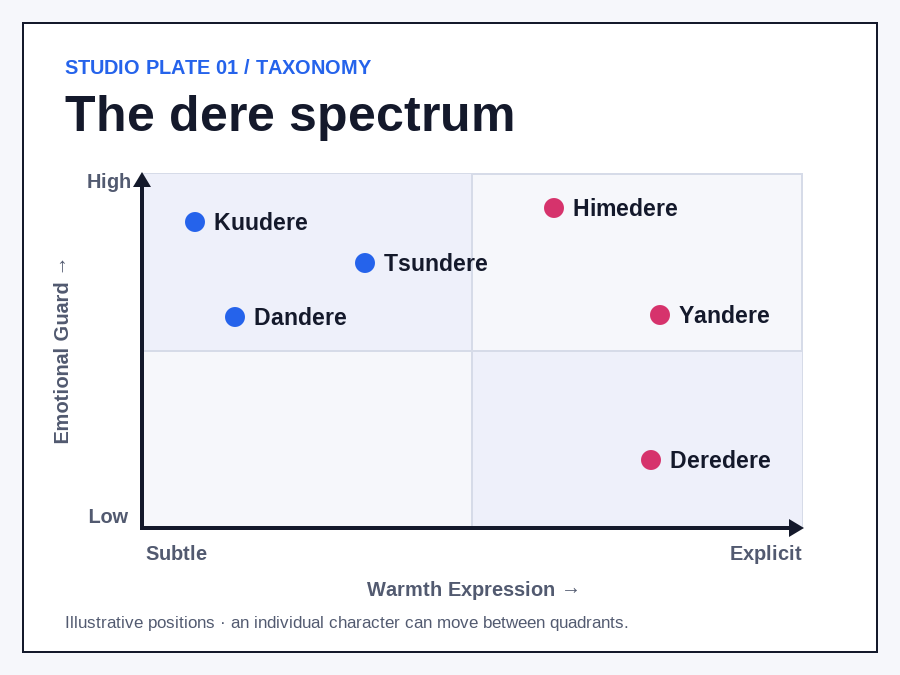
The Japanese expression dere-dere (でれでれ) can describe someone visibly softening in affection. Fans use -dere in character labels to contrast that warmth with another trait: a prickly front, a composed voice, a quiet room, or a need to be treated as someone special. The labels describe recurring devices in fiction. They are not an official Japanese personality system and do not require every character to fit one box.
Imagine that someone saves the last slice of cake for you. A Tsundere might insist it was left over; a Kuudere might quietly put it on your plate. A Dandere might text rather than say it aloud. A Deredere would tell you plainly that they saved it for you. The gift barely changes. The way the character makes the feeling visible changes everything.
Read the score as a character sketch
Choose the line you’d write for your character, not the line you find most admirable. Each scene contrasts two types. A stronger choice gives one type all three points; a milder choice splits them two to one. Each type appears once per chapter. Early scores can move quickly, and even after all 24 scenes, a tie is perfectly possible. The top two labels show two recurring responses, not a permanent identity.
Compare your pairing and clash as writing prompts. A cool response to a big declaration can be a slow burn or an argument depending on whether it gives the other character room. A Yandere story uses fixation to create tension; it should never call coercion a proof of love. The sixteen-type index separates the scored traits from four extra fandom labels.
Finish, save, or share
The saved result card is a vertical 1200 × 1500 image. It records the top six affinities, the leading two types and a pairing note without listing your answers. The result link instead preserves all 24 choices. Your last answers and display mode can stay in this browser; use Reset to erase the saved quiz. Privacy details explain how this differs from public comments.
Glossary sources: Shogakukan: dere-dere · Shogakukan: tsundere
No comments yet.